CONTENT INDEX
- 1. How commercial outsourcing has evolved
- 2. What does your tech company really need?
- 3. Which functions make sense to outsource today?
- 4. How to choose the right partner and avoid mistakes
- 5. When is the right time to get started?
In the technology industry, speed — having everything ready on time and growing fast — is a determining factor. In fact, many technology scaleups are not held back by a lack of product, or by a lack of ambition, but by a lack of commercial capacity to execute at the pace the market demands.
At Springboard, we see this almost every day when speaking with CEOs of B2B technology scaleups: the big question is not whether there is growth potential, but how to capture it without overloading the internal team. At this stage, the company has already validated its product or solution, has a value proposition and knows it can compete. The challenge appears when it needs to open new markets, generate opportunities, validate segments, adapt the message, build relationships and close the first sales all at the same time.
It is not just about defining a good strategy, but about having enough execution capacity. When the founding team tries to handle everything internally, a bottleneck usually appears: priorities pile up, processes are not clearly defined, opportunities move forward more slowly and the company starts to depend too much on a few key people. This ends up slowing down other critical areas of the business and creates significant organizational stress.
This difficulty becomes especially critical at the beginning of an expansion. Before having clear traction in a new market, hiring an in-house team can be slow, expensive and risky. The company does not yet know for certain what profiles it needs, what commercial message will work, what type of client will respond best or how long it will take to convert the first opportunities. And yet, the market does not wait. While the company is trying to build the perfect internal structure with processes and onboarding, things continue to happen externally: competitors open conversations, build trust, capture strategic accounts and occupy spaces that will later be much harder to recover.
Moreover, scaling exclusively with an in-house team is not always realistic: hiring strong commercial profiles in B2B technology is difficult, especially when looking for people with sector experience, local market knowledge, a network of contacts and the ability to sell complex solutions.
That is why a company that decides not to outsource any component of its commercial development can end up getting stuck in its growth.
Outsourcing part of the commercial effort can help unlock this situation. When a scaleup enters a new stage of expansion, it usually has to make decisions with incomplete information. That is why it does not only need execution, but also judgement, direct feedback from potential clients and signals that confirm whether there is real demand.
The truth is that outsourcing enterprise sales can raise many doubts: how can we accelerate customer acquisition without fixed costs compromising the viability of the project? Will it be a temporary solution? Will it work? Will they do it better than us? Will they be able to represent our brand properly?
In addition, it is not always easy to distinguish between a truly strategic partner and a provider that promises quick contacts and fast results. Many scaleups come across aggressive but vague commercial proposals, based on databases, cold calls or networks of contacts that are difficult to verify.
That is why the ideal partner should not act merely as a sales provider, but as an extension of the team. Someone who can truly understand a technological solution, the ins and outs of the market and the complexity of the B2B sales process. But also someone with a competent team, a training programme, proven experience and enough commitment to walk alongside the company, represent it with judgement and protect its positioning in every conversation.
With this article, we want to show you that sales outsourcing is not a temporary patch to get by; today, it is a real growth lever. But, to be honest, it is not magic: what it does is act as a catalyst that multiplies and accelerates the current state of your commercial model. It does not replace the foundations of your business; it amplifies what you already have. And that is precisely where we come in.
How commercial outsourcing has evolved: from “telemarketing” to real integration with your business
It is important to take a small step back when discussing how these processes traditionally worked and compare how their profitability and effectiveness for companies have evolved over the years.
For years, outsourcing sales was almost automatically associated with telemarketing: a model based on mass cold calling, repetitive scripts and an approach purely focused on increasing volume at all costs, without paying enough attention to the quality of the conversation. It was a useful model for certain businesses, but very limited when we talk about B2B technology solutions, with complex sales cycles and senior decision-makers.
Today, the market has changed. Commercial outsourcing can no longer be based on “making calls” or “contacting more people”. B2B sales have evolved from a repetitive model into a much more consultative model, where the quality of the approach, commercial intelligence and the ability to build trust matter much more than volume.
At Springboard 35, we believe that, for a collaboration to deliver real value in today’s SaaS world, it must be built on four fundamental pillars:
- A – Alignment with the ICP (Ideal Customer Profile): The external team must immerse itself in your value proposition until it understands the needs, pain points, philosophy of the company and language of your ideal customer with the same depth as your own team, acting as a true commercial extension of your business — as one of the team.
- B – Integration and technology base: to avoid misunderstandings with information, all tools, automations and data generated must be integrated into the startup’s CRM. This ensures that the company always maintains control, ownership of the data and full traceability of every interaction.
- C – Business-oriented quality: the team’s performance is not measured by the volume of activity in reports, or by the number of emails sent or calls made, but by the direct impact on the pipeline. The central focus must be on generating qualified opportunities with clear next steps; in other words, meetings with decision-makers who have a real need and budget to buy.
- D – Ability to iterate: the technology market moves fast. An effective sales strategy requires continuous analysis of how the market reacts, adjusting direction when necessary, personalizing the commercial pitch and adapting the message to the changing demands of the sector and your audience.
When a company’s commercial engine is built by combining these four key pieces in a coordinated way, outsourcing becomes the catalyst that allows CEOs to free up time to focus on product evolution/improvements and, above all, on the company’s strategic vision. Trying to cover everything can become a turning point for your startup, and this is something we know first-hand.
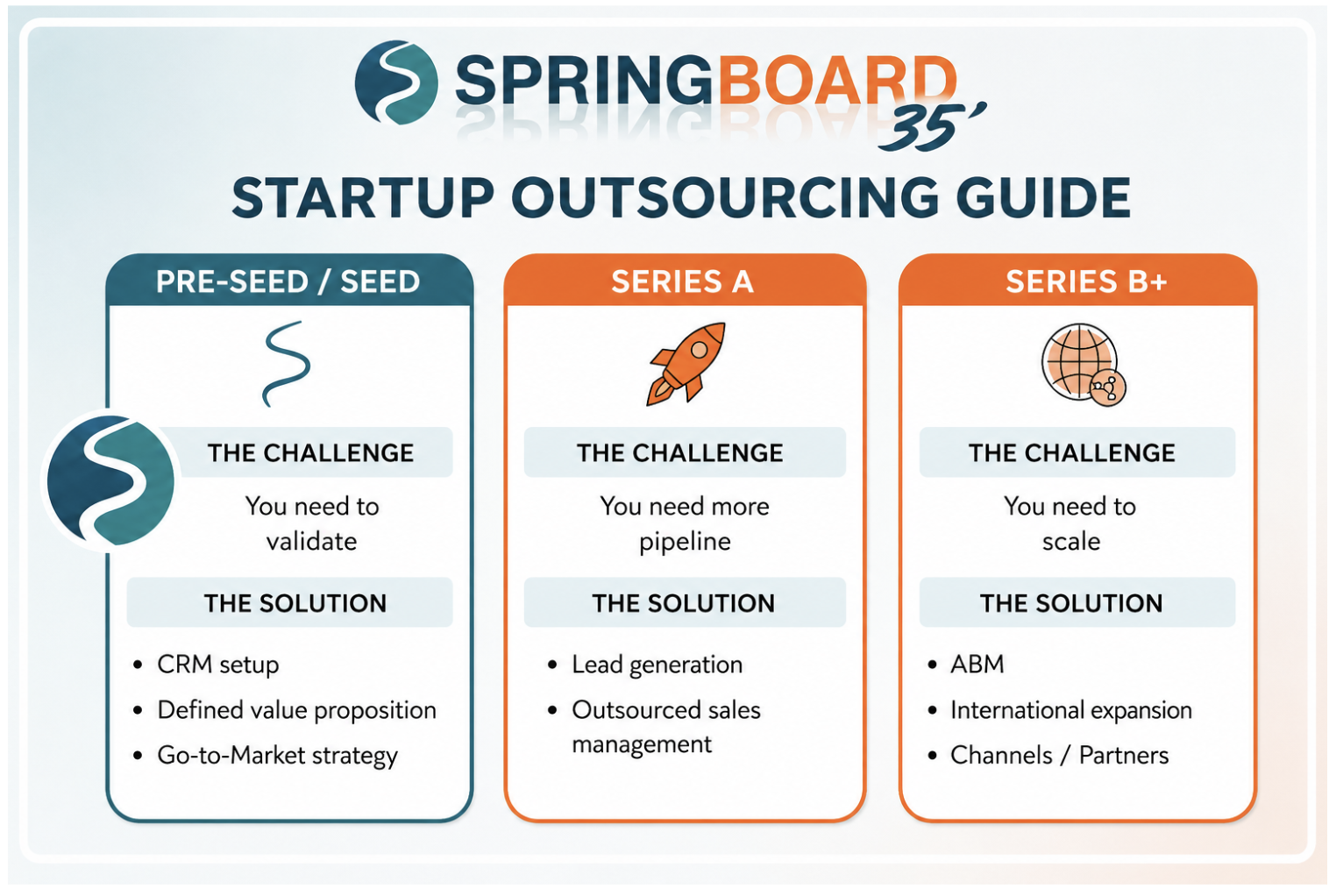
So, what does your tech company really need?
Not every growth stage requires the same thing. Trying to do everything at once may be the opposite of the solution you were expecting. This is how we see it:
Which functions make sense to outsource today?
The market has become highly specialized. It is no longer enough to have a database with up-to-date contacts; today, you need processes that work on their own.
- SDR as a Service: It is not about quantity, but about knowing where to go and how to start. In our business development services, what we do is qualify opportunities so that your Account Executives do not waste time on meetings that go nowhere. The SDR identifies target accounts, activates conversations, validates and qualifies interest so that the commercial team can focus on prospects with real potential.
- BDR as a Service: It is not only about generating meetings, but about opening markets with judgement. An external Business Development Manager acts as an extension of the commercial team: identifying strategic opportunities, understanding the client’s context, adapting the message, generating conversations with decision-makers and supporting the development of new accounts or markets. This role is especially key when the company needs to validate a segment, enter a market or build a qualified pipeline without having to hire an internal team from scratch.
- Revenue Operations (RevOps): Without a clear CRM, any commercial strategy loses effectiveness. Delegating the management of data architecture and automations brings technical clarity to the team, transforming complex processes into a fluid and predictable acquisition model. RevOps helps marketing, sales and customer success work with the same information, the same criteria and a shared vision.
- Outsourced Sales Management: In the early stages of growth, bringing in a full-time sales director or sales manager does not have to be your only option. What the project requires is strategic leadership focused on solving specific challenges: validating the pricing model, defining the go-to-market strategy or structuring the first sales playbook. Our support provides an experienced commercial team and a sales manager figure that adapts to your needs.
How to choose the right partner and avoid mistakes
Since these services are currently in high demand, the market offering can be very broad. For this reason, the main criterion for selecting a partner should be that your provider clearly understands your business value proposition.
When a provider does not confidently understand what stage your business is in, tactical execution usually translates into automated, low-value messages — a lot of spam. This type of aggressive campaign damages brand reputation and wears down the database without delivering results. That is why it is essential to choose strategic partners capable of integrating into your operations, guaranteeing optimal communication with the market and a strong return on investment.
When is the right time to get started?
The ideal time to outsource part of your commercial development should not be approached as a reactive decision, nor as an emergency solution when growth has already stalled. In a B2B technology scaleup, the right time usually appears when there is a clear tension between ambition and capacity.
Based on our experience in the sector, and after having worked with hundreds of companies in these situations, we know that the time to take the step comes when you identify these 3 signals in your organization:
- Misalignment between product quality and growth pace: A scenario in which companies have a strong product and talented technical teams, but lack the minimum commercial drive needed to scale on their own. The pipeline is irregular or not very predictable, opportunities depend heavily on referrals, inbound or occasional events, there is commercial activity, but it is difficult to understand what is really working. Delegating these external sales functions can immediately provide a clear, experienced and proven methodology to transform that potential into revenue.
- Limited resources and need for support — lack of time or team: Designing and maintaining a sales engine in continuous motion when you are starting out and have barely any time requires many hours and a level of specialization that scaleups often do not have in most cases. Delegating this execution provides the immediate operational support needed to remove bottlenecks without slowing down the pace of the business, and to optimize it without wasting time.
- Intention to expand into a new market or sector: When the objective is to open a new vertical or country, creating an internal structure from scratch involves a high financial risk. This point connects very well with the idea that outsourcing helps validate before building a fixed structure, without committing to long-term fixed costs.
When these conditions are met, taking this step becomes a strategic decision to accelerate growth. It allows you to professionalize the commercial engine immediately, shorten the time needed to start selling and avoid the fixed costs of building an internal department from scratch.
If you believe your scaleup is in this acceleration phase but need to define which first piece should move in your commercial strategy, do not hesitate to contact us.
At Springboard 35, we can carry out a quick diagnosis of your current situation to help you structure the process with maximum clarity and rigour.