
When and how to delegate your SaaS commercial engine to truly accelerate growth

Frame 76

CONTENT INDEX


In the technology industry, speed — having everything ready on time and growing fast — is a determining factor. In fact, many technology scaleups are not held back by a lack of product, or by a lack of ambition, but by a lack of commercial capacity to execute at the pace the market demands.

At Springboard, we see this almost every day when speaking with CEOs of B2B technology scaleups: the big question is not whether there is growth potential, but how to capture it without overloading the internal team. At this stage, the company has already validated its product or solution, has a value proposition and knows it can compete. The challenge appears when it needs to open new markets, generate opportunities, validate segments, adapt the message, build relationships and close the first sales all at the same time.

It is not just about defining a good strategy, but about having enough execution capacity. When the founding team tries to handle everything internally, a bottleneck usually appears: priorities pile up, processes are not clearly defined, opportunities move forward more slowly and the company starts to depend too much on a few key people. This ends up slowing down other critical areas of the business and creates significant organizational stress.

This difficulty becomes especially critical at the beginning of an expansion. Before having clear traction in a new market, hiring an in-house team can be slow, expensive and risky. The company does not yet know for certain what profiles it needs, what commercial message will work, what type of client will respond best or how long it will take to convert the first opportunities. And yet, the market does not wait. While the company is trying to build the perfect internal structure with processes and onboarding, things continue to happen externally: competitors open conversations, build trust, capture strategic accounts and occupy spaces that will later be much harder to recover.

Moreover, scaling exclusively with an in-house team is not always realistic: hiring strong commercial profiles in B2B technology is difficult, especially when looking for people with sector experience, local market knowledge, a network of contacts and the ability to sell complex solutions.

That is why a company that decides not to outsource any component of its commercial development can end up getting stuck in its growth.

Outsourcing part of the commercial effort can help unlock this situation. When a scaleup enters a new stage of expansion, it usually has to make decisions with incomplete information. That is why it does not only need execution, but also judgement, direct feedback from potential clients and signals that confirm whether there is real demand.

The truth is that outsourcing enterprise sales can raise many doubts: how can we accelerate customer acquisition without fixed costs compromising the viability of the project? Will it be a temporary solution? Will it work? Will they do it better than us? Will they be able to represent our brand properly?

In addition, it is not always easy to distinguish between a truly strategic partner and a provider that promises quick contacts and fast results. Many scaleups come across aggressive but vague commercial proposals, based on databases, cold calls or networks of contacts that are difficult to verify.

That is why the ideal partner should not act merely as a sales provider, but as an extension of the team. Someone who can truly understand a technological solution, the ins and outs of the market and the complexity of the B2B sales process. But also someone with a competent team, a training programme, proven experience and enough commitment to walk alongside the company, represent it with judgement and protect its positioning in every conversation.

With this article, we want to show you that sales outsourcing is not a temporary patch to get by; today, it is a real growth lever. But, to be honest, it is not magic: what it does is act as a catalyst that multiplies and accelerates the current state of your commercial model. It does not replace the foundations of your business; it amplifies what you already have. And that is precisely where we come in.

How commercial outsourcing has evolved: from “telemarketing” to real integration with your business

It is important to take a small step back when discussing how these processes traditionally worked and compare how their profitability and effectiveness for companies have evolved over the years.

For years, outsourcing sales was almost automatically associated with telemarketing: a model based on mass cold calling, repetitive scripts and an approach purely focused on increasing volume at all costs, without paying enough attention to the quality of the conversation. It was a useful model for certain businesses, but very limited when we talk about B2B technology solutions, with complex sales cycles and senior decision-makers.

Today, the market has changed. Commercial outsourcing can no longer be based on “making calls” or “contacting more people”. B2B sales have evolved from a repetitive model into a much more consultative model, where the quality of the approach, commercial intelligence and the ability to build trust matter much more than volume.

At Springboard 35, we believe that, for a collaboration to deliver real value in today’s SaaS world, it must be built on four fundamental pillars:

  • A – Alignment with the ICP (Ideal Customer Profile): The external team must immerse itself in your value proposition until it understands the needs, pain points, philosophy of the company and language of your ideal customer with the same depth as your own team, acting as a true commercial extension of your business — as one of the team.
  • B – Integration and technology base: to avoid misunderstandings with information, all tools, automations and data generated must be integrated into the startup’s CRM. This ensures that the company always maintains control, ownership of the data and full traceability of every interaction.
  • C – Business-oriented quality: the team’s performance is not measured by the volume of activity in reports, or by the number of emails sent or calls made, but by the direct impact on the pipeline. The central focus must be on generating qualified opportunities with clear next steps; in other words, meetings with decision-makers who have a real need and budget to buy.
  • D – Ability to iterate: the technology market moves fast. An effective sales strategy requires continuous analysis of how the market reacts, adjusting direction when necessary, personalizing the commercial pitch and adapting the message to the changing demands of the sector and your audience.

When a company’s commercial engine is built by combining these four key pieces in a coordinated way, outsourcing becomes the catalyst that allows CEOs to free up time to focus on product evolution/improvements and, above all, on the company’s strategic vision. Trying to cover everything can become a turning point for your startup, and this is something we know first-hand.

So, what does your tech company really need?

Not every growth stage requires the same thing. Trying to do everything at once may be the opposite of the solution you were expecting. This is how we see it:
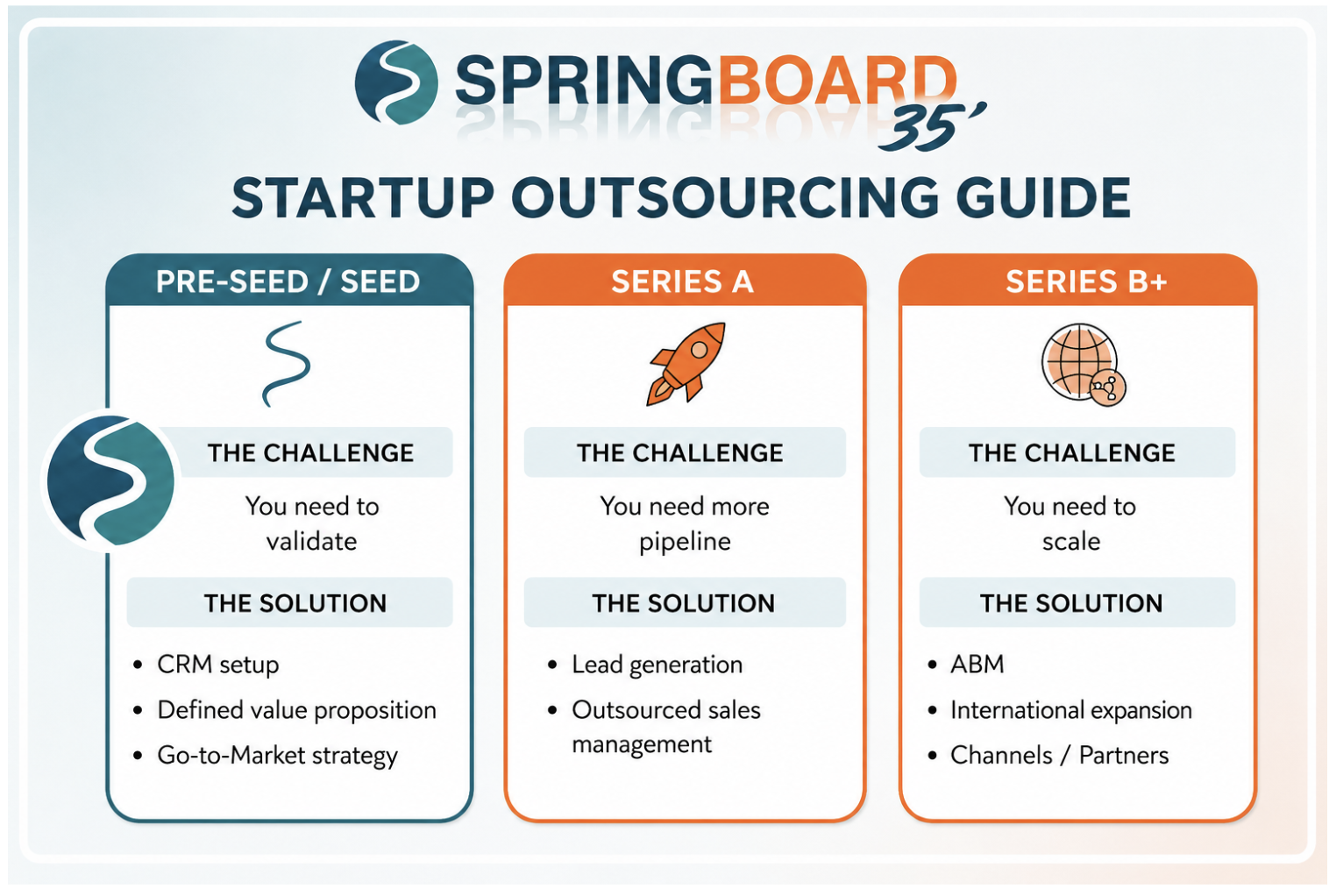
startup-outsourcing-guide

Which functions make sense to outsource today?

The market has become highly specialized. It is no longer enough to have a database with up-to-date contacts; today, you need processes that work on their own.

  • SDR as a Service: It is not about quantity, but about knowing where to go and how to start. In our business development services, what we do is qualify opportunities so that your Account Executives do not waste time on meetings that go nowhere. The SDR identifies target accounts, activates conversations, validates and qualifies interest so that the commercial team can focus on prospects with real potential.
  • BDR as a Service: It is not only about generating meetings, but about developing the market, converting opportunities, and closing deals. In an outbound sales process, an external Business Development Manager acts as an extension of the sales team: they identify strategic opportunities, understand the client’s context and needs, adapt the value proposition, generate conversations with decision-makers, and support the entire sales process, from account opening to negotiation and deal closing. Their role is especially relevant when a company needs to validate a segment, enter a new market, accelerate customer acquisition, or build a qualified pipeline without having to create an internal team from scratch.
  • Revenue Operations (RevOps): Without a clear CRM, any commercial strategy loses effectiveness. Delegating the management of data architecture and automations brings technical clarity to the team, transforming complex processes into a fluid and predictable acquisition model. RevOps helps marketing, sales and customer success work with the same information, the same criteria and a shared vision.
  • Outsourced Sales Management: In the early stages of growth, bringing in a full-time sales director or sales manager does not have to be your only option. What the project requires is strategic leadership focused on solving specific challenges: validating the pricing model, defining the go-to-market strategy or structuring the first sales playbook. Our support provides an experienced commercial team and a sales manager figure that adapts to your needs.

How to choose the right partner and avoid mistakes

Since these services are currently in high demand, the market offering can be very broad. For this reason, the main criterion for selecting a partner should be that your provider clearly understands your business value proposition.

When a provider does not confidently understand what stage your business is in, tactical execution usually translates into automated, low-value messages — a lot of spam. This type of aggressive campaign damages brand reputation and wears down the database without delivering results. That is why it is essential to choose strategic partners capable of integrating into your operations, guaranteeing optimal communication with the market and a strong return on investment.

When is the right time to get started?

The ideal time to outsource part of your commercial development should not be approached as a reactive decision, nor as an emergency solution when growth has already stalled. In a B2B technology scaleup, the right time usually appears when there is a clear tension between ambition and capacity.

Based on our experience in the sector, and after having worked with hundreds of companies in these situations, we know that the time to take the step comes when you identify these 3 signals in your organization:

  • Misalignment between product quality and growth pace: A scenario in which companies have a strong product and talented technical teams, but lack the minimum commercial drive needed to scale on their own. The pipeline is irregular or not very predictable, opportunities depend heavily on referrals, inbound or occasional events, there is commercial activity, but it is difficult to understand what is really working. Delegating these external sales functions can immediately provide a clear, experienced and proven methodology to transform that potential into revenue.
  • Limited resources and need for support — lack of time or team: Designing and maintaining a sales engine in continuous motion when you are starting out and have barely any time requires many hours and a level of specialization that scaleups often do not have in most cases. Delegating this execution provides the immediate operational support needed to remove bottlenecks without slowing down the pace of the business, and to optimize it without wasting time.
  • Intention to expand into a new market or sector: When the objective is to open a new vertical or country, creating an internal structure from scratch involves a high financial risk. This point connects very well with the idea that outsourcing helps validate before building a fixed structure, without committing to long-term fixed costs.

When these conditions are met, taking this step becomes a strategic decision to accelerate growth. It allows you to professionalize the commercial engine immediately, shorten the time needed to start selling and avoid the fixed costs of building an internal department from scratch.

If you believe your scaleup is in this acceleration phase but need to define which first piece should move in your commercial strategy, do not hesitate to contact us.

At Springboard 35, we can carry out a quick diagnosis of your current situation to help you structure the process with maximum clarity and rigour.

Rate this post

What are the best outsourced sales services for tech scaleups?

servicios de ventas externas para scaleups

TABLE OF CONTENTS


In the tech scaleup ecosystem (SaaS, cybersecurity, cloud, infrastructure, devtools), growth isn’t optional—it’s survival. However, scaling an internal sales team from scratch is often slow, expensive, and risky. That is exactly where sales outsourcing comes in.

If you are looking for the absolute “best” outsourced sales service, here is the reality: there is no single number one; there are only best fits based on your specific use case. Below, we break down the names that consistently show up in the market, categorized by their strengths, alongside a strategic framework to help you choose without wasting your budget.


1. The Leaders in SDR Outsourcing & Pipeline Generation

If your product already has Product-Market Fit (PMF) and your sole focus is keeping your Account Executives’ (AEs) calendars packed, these are the go-to agencies in the tech space:

  • memoryBlue: One of the sturdiest giants if you need an “industrialized” partner to scale outbound efforts fast. They are heavily focused on tech, boasting over 600 active AEs/SDRs and global support across 30+ languages. They are the ideal choice to build raw pipeline due to their massive capacity to scale.
  • Belkins: The specialists in highly customized outreach and appointment setting. They excel at navigating complex tech sale dynamics: 6-to-12-month sales cycles, multiple stakeholders, and heavily regulated environments.
  • Martal Group: A must-have on your short list if you need hybrid coverage between North America and Europe. They specialize in highly consultative messaging and prospecting tailored toward mid-market and enterprise accounts.
  • SalesRoads: If you prioritize processes, deep reporting, and operational consistency over a “sexy startup brand,” SalesRoads is a clear leader in pipeline generation and inside sales.
  • CIENCE: A massive outbound SDR machine providing broad GTM (Go-To-Market) support. They offer proprietary tooling and highly standardized playbooks, making them a great fit if you want high volume and structured operations. Their rough pricing starts around $2,499/month plus setup, though it varies by project scope.


2. Fractional Sales Leadership: Is the Problem Prospecting or Strategy?

Sometimes, a scaleup’s core issue isn’t a lack of meetings—it’s the absence of a mature sales strategy. If you aren’t ready to hire a full-time VP of Sales yet, fractional leadership is the answer:

  • Sales Xceleration: Focused on providing part-time VP of Sales leadership. They design your strategy, processes, management systems, and growth foundations. This is the perfect fit if your product works but your internal sales execution is inconsistent.
  • Chief Outsiders: They provide senior fractional executives specializing in growth, sales, and GTM with direct experience in SaaS, cloud, and enterprise sales. Best used when you need to crack open a new market segment, pivot your positioning, or professionalize your entire revenue engine.


3. Quick Breakdown: Which One Fits Your Needs?

To make your life easier, here is the quick matching guide based on your actual business goals:

  • Want fast pipeline in B2B tech and room to scale?: memoryBlue, Belkins, or Martal Group.
  • Want more meetings backed by strict operational discipline?: SalesRoads or Belkins.
  • Need massive volume and standardized outbound frameworks?: memoryBlue or CIENCE.
  • Need to fix your sales strategy before hiring SDRs?: Sales Xceleration or Chief Outsiders.


The Definitive Short List for a Typical B2B Scaleup:
  1. memoryBlue
  2. Belkins
  3. Martal Group
  4. SalesRoads
  5. CIENCE
  6. Sales Xceleration (If you lack leadership)
  7. Chief Outsiders (If you need a fractional VP/CRO)


4. Buyer’s Guide: How to Choose Wisely (For Real)

Do not hire an agency based purely on a ranking or a sleek website. Before signing anything, grill them with these questions on your initial discovery call:

1. Are you selling me meetings or revenue?

Many agencies optimize for the sheer number of booked calls to hit their contract quotas, regardless of whether they match your pipeline criteria or turn into closed-won deals. Demand a focus on qualified opportunities.

2. Do I already have a validated ICP, messaging, and process?

Be brutally honest here. If your internal team can’t book meetings because the messaging doesn’t resonate, an external agency won’t fix it. Clear up your positioning first; outsource second.

3. Does my average deal size justify external outbound?

The more enterprise and highly technical your product is, the more critical it is that the agency has deep, proven niche experience.

4. Do I get a dedicated or a shared team?

Steer clear of shared teams if your product is complex. For the pace and demands of a tech scaleup, a dedicated team is almost always the only real option.

5. What exactly does their scope cover?

Clarify who handles lead list building, copywriting, email deliverability (to stay out of spam), cold calling, LinkedIn touchpoints, qualification, and handling no-shows.

6. How do we measure success?

Demand clear, transparent tracking for: meetings held (not just booked), opportunities accepted, pipeline created, CAC (or cost per opportunity), ramp time, and show rate.


Our Honest Take

The single biggest mistake tech scaleups make is externalizing sales out of desperation, hoping an agency will magically save their quarter.

Hiring an outbound agency when you still lack clarity on your Ideal Customer Profile (ICP), your core narrative, or your market segmentation is a surefire recipe for failure. Outsourcing accelerates what already works; it does not fix what is fundamentally broken.

  • If your homework is done and your strategy is validated: Go straight to memoryBlue, Belkins, or Martal Group.
  • If you are still figuring out how to build a repeatable sales process: Invest in fractional leadership before putting an external SDR team to work burning through your addressable market.
Rate this post

Is AI Draining Your Web Traffic and B2B Inbounds? How to Go on the Offensive

seo en la era ia

TABLE OF CONTENTS


Lately, in our meetings with tech companies in the SaaS and B2B services sectors, we share the same concern: “The drop in website leads is directly hitting the funnel, and the impact on the business is already being felt.”

If you’ve noticed a decline in your organic acquisition metrics over the last few months, you are not alone. It is a widespread challenge across the industry. With the arrival of Google AI Overviews, Perplexity, or ChatGPT, user behavior has shifted drastically.


The New Scenario: Why Traditional SEO is No Longer Filling Your Funnel

Users are no longer clicking on the “usual links.” When looking for a solution, they get a direct answer from the AI right on the search results page. Passive traffic is running dry.   The Paradigm Shift in B2B Acquisition:

  • Before (Pure Inbound): The user searched, compared 4 blogs, clicked, and filled out a form. 100% dependency on the algorithm.
  • Now (The AI Era): AI summarizes the options. Clicks are reduced. Acquisition now requires proactivity and direct contact with the Decision-Maker.


The Solution: Balancing the Funnel with Strategic Outbound

When Inbound weakens due to external factors, strategic Outbound is your best lifeline. It’s not about mass spamming; it’s about going on the offensive with surgical precision. To regain control of your revenue without depending on the mood swings of Google’s algorithms, your strategy must pivot on three pillars:

1. Surgical Prospecting

You can no longer wait to be found. You must identify and contact the exact decision-makers who have the problem you solve, analyzing their current buying signals.

2. Proactive Lead Generation Campaigns

Designing multichannel communication sequences (LinkedIn, Email, Phone) based on value and personalization. The goal is to spark interest in accounts that weren’t even searching on Google that day.

3. Qualified Appointment Setting

Success is not measured in clicks; it’s measured in high-quality meetings. Filling your sales team’s calendar with real opportunities so they only have to worry about one thing: closing deals.  


Take Control of Your B2B Growth

Don’t leave the future of your revenue in the hands of Artificial Intelligence. At Springboard35, we help tech companies recover their sales funnel and exceed their business goals through proactive Outbound methodologies. Want us to analyze your current sales process? Schedule a strategic session with our team and let’s map out your action plan.  

Rate this post

7 Strategic Steps to Identify Real Decision-Makers in B2B Sales

decision maker

In long-cycle, high-complexity sales, unmanaged optimism is a financial liability. Too often, sales teams mistake a “great rapport” with a contact for an advanced deal. However, in the tech sector, there is a cold, hard truth: you can win the person over, but if you haven’t won over the organization, there is no contract.

At Springboard35, through analyzing our clients’ expansion processes, we’ve observed that the primary bottleneck isn’t a lack of interest—it’s a failure to map the power centers. Identifying who holds the real authority (and the budget) is the first rule of protecting the time-to-market for any innovative solution.

Here are 7 strategic steps to pinpoint the true decision-makers in complex organizations.

1. Context Over Titles: From Job Description to Responsibility

A recurring mistake is prospecting based solely on job titles. In flat structures or massive multinationals, titles can be deceptive. Your first step is to define who “feels the pain” of not having your solution. If your tech optimizes cash flow, your target is the CFO. If your software prevents plant downtime, it’s the Head of Operations. Look for the person whose primary KPIs are directly impacted by the problem you solve.

2. Deconstructing the Decision-Making Unit (DMU)

In modern B2B sales, decisions are made by consensus. To navigate successfully, you must map the roles within the account:

  • The User: The one who will live in the tool and validate usability.
  • The Influencer: The technical profile (IT, Security, Legal) who can veto the project if it doesn’t meet their standards.
  • The Economic Buyer: The person who signs off on the budget. Understanding the power hierarchy between these roles is what separates a strategic sale from a mere “pitch.”

3. Leveraging LinkedIn Sales Navigator for Intelligence

Beyond basic filters, the key lies in trigger events. An executive who joined the company in the last 6 months usually has a mandate for change and a fresh budget window. “New blood” in leadership is often the shortest path to a buying decision.

4. Qualification Through Control Questions

Professionalism is defined by the courage to ask the right questions. Don’t be afraid to elegantly validate your contact’s authority:

“To ensure this project aligns with the company’s annual priorities, which other departments typically participate in the final sign-off?” If the response is vague or evasive, it’s a clear signal you’re talking to an information gatherer, not a decision-maker.

5. Identifying and Equipping the “Champion”

The Champion (or Trojan Horse) is your internal ally, but not necessarily the one who signs the contract. Their value lies in their influence and access to “the room where it happens.” Your job is to arm them with a bulletproof Business Case: ROI data, market benchmarks, and risk analysis. Turn them into the internal advocate for your solution.

6. The “Lateral Entry” Strategy

When access to the C-suite is blocked, use middle management for Discovery. Gathering data on current operational friction allows you to approach the real decision-maker later with a razor-sharp, personalized value proposition. It shows you understand their problems better than the competition does.

7. Decoding Authority Dynamics in the Boardroom

In group meetings, authority is often silent. Watch the room: who sets the pace of the conversation? To whom do others look when timelines or investments are mentioned? The real decision-maker isn’t always the loudest person—they are the one asking about strategic impact and long-term scalability.


Is your sales strategy hitting the right target?

Identifying decision-makers isn’t an administrative task; it’s an investigative discipline. In sectors like Industry 4.0 or Enterprise SaaS, where resources are tight and competition is fierce, you cannot afford to talk to the wrong people.

At Springboard35, we specialize in this critical mapping. We act as the sales engine that identifies, qualifies, and opens the doors to the offices where decisions are actually made—allowing your team to focus on what they do best: closing deals.

Ready to optimize your funnel and reach the real decision-maker faster? Let’s talk growth.

Rate this post

How to Sell Industrial SaaS When the Client Isn’t Seeking Innovation, but Continuity and ROI

advanced factories

In today’s tech ecosystem, terms like “Generative AI” or “Digital Transformation” dominate the narrative. However, when a software sales team steps onto a manufacturing floor, the language changes completely. Industrial manufacturers don’t buy technology out of enthusiasm for the “new”; their logic is pragmatic: reduce risk, protect production, and achieve a tangible return.

At Springboard35, we observe a recurring pattern: many industrial SaaS companies stall not because of poor product quality, but because they sell like a traditional startup to organizations that buy with an industrial mindset.

1 The Industrial Buyer’s Mental Code

To sell successfully, you must first understand that the client is conditioned by past bad experiences: “pilot purgatory” or integrations that paralyzed their production. In this sector, nobody wants to innovate for innovation’s sake; the absolute priority is operational continuity. The sales process should not seek to “generate hype,” but rather to help the client buy with peace of mind.


2. Forget the Generic ICP: Speak the Language of the Plant

Saying your client is a “mid-sized manufacturer” is useless. An automotive manufacturer has processes and regulatory pressures entirely different from a pharmaceutical plant. To make your message resonate, you must build an Ideal Customer Profile (ICP) based on their operational reality:

  • Tech Stack: What ERP or SCADA systems do they use?
  • Real Drivers: Are they obsessed with reducing downtime, energy savings, or scrap reduction?
  • Digital Maturity: You cannot offer advanced AI to someone still struggling with basic legacy systems.

3. Sell Use Cases, Not Features

Your client doesn’t care if your architecture is cloud-native or if you use machine learning. The client buys operational results.

  • Common Error: “We have an AI-based monitoring platform.”
  • Winning Approach: “We help reduce unplanned downtime of critical assets in less than 12 months.” Industrial credibility is built on realistic improvement ranges and believable payback horizons.


4. Industrial Discovery: Detect Fear, Not Just the Problem

The real friction in an industrial sale isn’t a lack of need; it’s the fear of change. Your discovery process must dig deep into:

  • Political Risks: What happens internally if the project fails?
  • Operational Constraints: What are the maintenance windows? Which systems are “untouchable”?


5. From “Eternal Pilots” to Structured Pilot Packages

Many industrial SaaS firms improvise every Proof of Concept (PoC), which creates uncertainty and delays scaling. The key to avoiding “pilot purgatory” is offering structured packages:

  • Limited scope and fixed duration.
  • Success KPIs defined from day one.
  • An explicit path to full deployment following validation.


6. The Business Case: Don’t Leave Your Sponsor Alone

Your internal contact needs to defend the investment before Finance, Procurement, and Executive Leadership. Don’t let them do it alone. You must actively provide them with the ROI narrative and the deployment plan. Since total ROI can take time, use intermediate metrics (such as incident reduction or connected lines) to demonstrate quick “political value” within the organization.


7. Master the Buying Committee (Multistakeholder)

In industry, closing depends on several actors with often opposing interests:

  • Operations seeks stability.
  • IT/Cybersecurity demands governance.
  • Procurement wants to minimize vendor lock-in. You must have a tailored pitch and specific FAQs for each of them.


8. The Real Close Happens After the Signature

In industrial SaaS, signing the contract is just the beginning. The first 90 days determine whether your solution becomes a standard or a forgotten failure. You must ensure value is perceived quickly so your sponsor maintains their internal credibility.


Attending Advanced Factories 2026? 

At Springboard35, we help SaaS companies move from “eternal pilots” to real, scalable deployments by adapting their sales systems to the complex reality of the industrial sector.

Selling industrial innovation isn’t about appearing disruptive—it’s about proving you can introduce improvements without putting operations at risk. Let’s talk during the event.

Rate this post

France Looks Toward Spain: Keys to Conquering the Cybersecurity Market (InCyber Forum Lille)

INCYBER

From March 31 to April 2, Lille will host a new edition of the InCyber Forum at a pivotal moment for European cybersecurity. Growing pressure regarding digital sovereignty has evolved from a mere technical debate into a strategic priority. France arrives at this event with a consolidated position, backed by a structured industry, strong public involvement, and world-class capabilities in critical areas such as infrastructure protection, digital identity, and data encryption.

However, this leadership also presents a challenge: growing beyond its own borders. In this context, all eyes are on Spain. With a rapidly expanding market, a developing regulatory environment, and increasing demand for cybersecurity solutions, Spain is emerging as a priority destination for French companies looking to scale within Europe.

With a market volume already exceeding €6.3 billion, the Spanish market is asserting itself as one of the primary growth levers in 2026 for the expansion of the French industry over the coming years.

Why Spain Now?

Expansion into the Spanish market is driven by a series of structural factors:

  • Economic growth outperforming the rest of Europe.
  • A cybersecurity market in full expansion (> €6.3B).
  • Regulations such as NIS2 and DORA that are accelerating investment.
  • Operational costs up to 30–40% lower.
  • Direct access to the public sector and large corporations.
  • A market with genuine demand that is not yet saturated.

This combination of variables creates a particularly favorable environment for tech companies in their expansion phase.

The Challenge of Execution in the Spanish Market

While market access does not represent an insurmountable barrier, execution remains the primary challenge. Many companies encounter difficulties related to:

  • Lack of access to the right decision-makers.
  • Unfamiliarity with local channels.
  • Regulatory barriers (CCN, ENS, and the public sector).
  • Commercial strategies poorly adapted to the Spanish context.

These factors can slow down entry and limit business development if they are not addressed correctly from the start.

Keys to Effective Expansion

Success in the Spanish market requires a structured approach that combines:

  1. Direct access to key decision-makers.
  2. Development of local channels and integrators.
  3. Adaptation to regulatory requirements.
  4. Commercial strategies aligned with the local market.
  5. Early pipeline generation.

Companies that adopt this approach succeed in accelerating their positioning and reducing their time-to-market.

The Role of Springboard

Springboard acts as the commercial arm in Spain for international tech companies. With over 10 years of experience and numerous projects in the cybersecurity field, its model is based on facilitating entry and accelerating commercial development in the local market. Their capabilities include:

  • Access to decision-makers in large corporations.
  • Channel and integrator development.
  • Support for certifications and public sector access.
  • Pipeline generation from the earliest stages.

The goal is to accompany companies in building a solid and sustainable presence in Spain.

Analysis Content

The report addresses the primary factors defining the Spanish market in 2026:

    • Macroeconomic context and performance relative to other European markets.
    • Structure and growth of the Spanish cybersecurity market.
    • Talent availability and operational cost efficiency.
    • Tax incentives and support for R&D+i.
    • Major tech hubs and innovation clusters (Malaga, León).
    • Case studies of French companies in Spain (Tehtris, Wallix, Advens).
    • Spain as a platform for access to Latin America.
 

Access the full analysis of the cybersecurity market in Spain

Rate this post

How to Evaluate a Market by Combining Market Attractiveness + PESTEL

pestel

Why analyzing a market size isn’t enough

When a company seeks to expand into new markets, launch a product, or identify new business opportunities, one of the first steps is typically to analyze market size.

However, basing a strategic decision solely on isolated figures can lead to incomplete conclusions.

A large market is not always an attractive one. Similarly, a promising market may hide regulatory, competitive, or cultural barriers that hinder entry.

This is why companies making strategic decisions combine two key approaches:

  • Market Attractiveness Analysis

  • PESTEL Macro-Environmental Analysis

Combining these provides a more comprehensive view to evaluate opportunities and prioritize markets effectively.


Market Attractiveness Analysis: Beyond Market Size

One of the most common pitfalls in market analysis is focusing exclusively on size.
While market size (TAM, SAM, or SOM) is important, it doesn’t answer the fundamental question:

Is it actually viable to compete and generate business in that market?

An attractive market typically exhibits several key characteristics:

1-Real Demand Exists

The market must have a clear need for your solution. It is not enough for a large industry to exist; customers must perceive value in your value proposition.

This is where high-quality B2B market research allows you to validate opportunities and understand customer behavior. Learn more about our Market Research services:

2-Healthy Profit Margins

A market with heavy price pressure or high acquisition costs can be difficult to monetize, even if potential volume is high.

For this reason, many companies combine market analysis with Business Development strategies to identify segments with higher potential.

3-Manageable Competition

Competition isn’t always a negative sign; in fact, it usually indicates existing demand.

The problem arises when the market is saturated or dominated by massive incumbents.

In such cases, an effective strategy may involve entering through local partners or commercial channels.

4-Accessible Customers

Especially in B2B environments, it is essential to analyze:

  • The sales cycle

  • Accessibility of decision-makers

  • Complexity of the procurement process

A market may look attractive on paper, but if customer access is difficult, commercial costs can skyrocket.


PESTEL Analysis: Understanding the Market Environment

While attractiveness analysis focuses on the market itself, a PESTEL analysis evaluates the context in which that market operates. PESTEL examines six external factors:

  • Political

  • Economic

  • Social

  • Technological

  • Environmental

  • Legal

This approach helps identify risks and opportunities that could impact business development.

Political and Regulatory Factors

Regulations can either facilitate or block market entry. For instance:

  • Required licenses

  • Regulatory restrictions

  • Government policies

This is particularly relevant in regulated sectors such as Energy, Fintech, or Healthcare.

Economic Factors

The economic climate directly influences business viability. Key variables include:

  • Economic growth (GDP)

  • Inflation

  • Financial stability

  • Available investment

Technological Factors

Technology adoption can accelerate the entry of new solutions or create barriers for new players.


Why the Combination of Attractiveness + PESTEL is Key

Analyzing market attractiveness alone can result in a “tunnel vision” perspective. Likewise, analyzing the macroeconomic environment without understanding the specific market niche is insufficient.

The combination of both approaches allows you to:priorizar mercados antes de invertir

  • Prioritize markets before investing capital.

  • Design international expansion strategies with precision.

  • Mitigate risks.

  • Accelerate time-to-market

This type of analysis transforms market research into a strategic tool for corporate growth.

From Market Research to Business Development

Market analysis only holds value if it translates into concrete actions.
At Springboard35, we help tech companies turn analysis into commercial growth through several specialized services:

Market Research
Research to validate opportunities, analyze competitors, and detect high-potential niches.

Business Development
Specialized business development to identify commercial opportunities and accelerate sales.

SDR Sales Force
Specialized teams focused on lead generation and setting qualified meetings with potential clients.

Channel Development
Identifying strategic partners to facilitate entry into new markets.

Sales Outsourcing
Externalized sales teams to accelerate international expansion.


Key Takeaways

A market may seem attractive on paper, but without understanding its external context, it is easy to overestimate its real potential.

By combining Market Attractiveness with PESTEL analysis, companies gain a 360-degree view, enabling more robust strategic decisions.

This approach specifically helps companies—particularly B2B tech firms—to:

  • Identify genuine expansion opportunities.

  • Reduce risks associated with entering new markets

  • Accelerate commercial growth with greater confidence.


At Springboard35 we apply this framework as part of our strategic process to help B2B tech companies evaluate new markets, develop business, and increase sales in new territories.

Rate this post

Springboard 35 and MEAReach FZ LLC Announce Strategic Middle East & Africa Expansion Alliance

Logos de Springboard & MEA Reach

Springboard 35 has entered into a strategic alliance with MEAReach FZ LLC to accelerate technology vendor and partner expansion across the Middle East & Africa.

The Middle East & Africa region represents one of the most dynamic and fast-growing technology markets globally — but successful expansion requires structured execution, trusted networks, and deep regional expertise.

This alliance is driven by Jean Obeid and Roy Chalhoub, founders of MEAReach FZ LLC, who each bring over 25 years of leadership experience in regional growth, commercial strategy, and market expansion within multinational technology organizations, including but not limited to Microsoft and Autodesk. Their combined expertise and established networks position MEAReach FZ LLC as a strong execution partner across the region.

Through this partnership, we support Springboard 35 clients looking to expand into the Middle East & Africa by combining our international ecosystem with MEAReach FZ LLC’s on-the-ground leadership, delivering structured market entry, channel development, and
localized execution frameworks to enable partners to enter, scale, and grow with confidence and speed.

The Middle East & Africa is not simply a new geography — it is a strategic growth lever.

Together, we are building the bridge.


Rate this post

The MWC 2026 stands no B2B tech company should overlook

mwc-barcelona-2026

A practical guide to coming back with more than a stack of business cards

The Mobile World Congress has a particular quirk: it’s remarkably easy to leave with your head full of ideas… and your CRM empty.
If you’re a B2B tech company — whether a startup, a scale-up or an established business in growth mode — you will either have experienced this already or can readily imagine it. Constant movement, interesting people, promising conversations. Then you return to the office and reality sets in: follow-ups go unanswered, meetings never materialise, and you’re left with the vague sense that the event was “good” — but you’re not entirely sure what it actually delivered.
MWC 2026 will, once again, be vast. That is precisely the challenge. When there is too much, decision-making becomes diluted. And when choosing feels difficult, most people default to the same approach: wander, browse, improvise and “see what happens”. This guide is designed to prevent that.
This is not a list of visually impressive stands, nor a ranking by size. It is a selection based on a single criterion: where a B2B tech company is most likely to generate tangible value (strategic partnerships, channel access, enterprise clients, integrations, pilot projects). And yes, I will also explain why it may be commercially sensible to speak with us during MWC if your objective is to leave with opportunities that can genuinely be progressed.


Before naming names: MWC success is prepared before, not captured during

This may sound obvious, but it is frequently overlooked. MWC does not reward the company that “sees the most”; it rewards the one that arrives with a plan. By “plan”, I do not mean an unwieldy spreadsheet. I mean three precise elements:

  • Who you intend to sell to (and who actually makes the decision)
  • The business problem you solve (expressed in commercial, not pitch, language)
  • What you aim to secure in four days (meetings, PoCs, partners, channel agreements, investment…)

If you have clarity on these points, stands become opportunities. Without it, they become technology tourism.


Operators: large, certainly — but still capable of opening doors that take years to unlock

For many B2B companies, the stands of operators such as Telefónica, Orange or Deutsche Telekom fall into the category of “we should probably stop by” — which often becomes “if there’s time”. In commercial terms, that is usually a mistake.
Not because you will close a contract on the spot. That is rarely the objective. The value lies elsewhere. A well-managed relationship with an operator can provide three assets that are extremely difficult to secure independently:

  • Access to large enterprise accounts (the ones that do not respond to cold outreach)
    Distribution (channel partnerships, co-selling, ecosystem leverage)
    Market validation (interest from a telco materially shifts perception among other stakeholders)

The unspoken reality: if you approach with a generic message such as “we use AI” or “we are a platform”, it will not resonate. What works in these environments is specificity: “In this sector, with this use case, we achieved these measurable results, and the commercial model is structured as follows.” Concise, evidence-based, commercially grounded.


Large technology firms and consultancies: where decisions are made that later appear “serendipitous”

This is where many tech companies misjudge the opportunity. They see names such as Accenture, IBM or SAP and assume: “That’s not for us.” They then question how competitors gain access to major enterprise programmes.
The reality is more prosaic: large B2B deals rarely enter through the front door. They come via partners already embedded within the client. Whether one approves of them or not, these firms are frequently embedded.
Here, your objective may be:

  • To position yourself as a specialist component within a broader programme
  • To connect with teams already selling into your target market
  • To explore integrations that make your solution more readily procurable within enterprise environments

The framing is critical. The conversation is not “look at our product”; it is “would this help you resolve this category of issue for your clients?” That shift materially changes the dynamic.


Cloud, data and security: less spectacle, more structural impact

For B2B digital companies, there is an uncomfortable truth: growth is often driven less by additional demos and more by embedding yourself within the environments your target enterprises already use.
That is why it can be commercially astute to engage with organisations such as Cloudflare or Snowflake, to cite examples. Not to procure services on the day, but to:

  • Identify integrations that create access to new accounts
  • Understand how large enterprises are structuring their technology stacks
  • Connect with ecosystems already serving the clients you seek

These discussions may appear less dynamic than a pitch competition. However, they are often the ones that evolve into agreements with measurable commercial traction.


4YFN: highly valuable… provided you control the agenda

4YFN brings together startups, investors, corporates and open innovation teams. The upside can be significant. So can the noise.
The distinction between “productive” and “four days of interesting but inconclusive conversations” typically rests on a straightforward variable: pre-booked meetings. Arriving with six to ten carefully selected meetings can be highly effective. Arriving to “see what emerges” generally results in pleasant contacts and limited forward motion.
One further point: follow-up in this environment is critical. Waiting until you are back at your desk is often too late. Effective operators send follow-up messages while the conversations are still fresh.


Our presence at MWC 2026

firma email logo mobile

This year we will be attending the Mobile World Congress alongside our strategic partners, whose collaboration enables our participation and with whom we work in a coordinated manner throughout the year.
On the financial and strategic side, we are joined by Fenix DFA, specialists in financial structuring, corporate strategy and supporting technology companies through growth, investment and scalability processes. Their perspective complements the commercial positioning work required when companies aim to enter larger accounts or new markets.
In the field of digital identity and security, we collaborate with Candour Identity, operating in an area that is increasingly critical in enterprise and regulated environments. Our shared approach is clear: robust technology aligned with explicit business objectives.
Our presence at MWC is deliberate. It reflects sustained collaboration with partners who understand that growth, positioning, financing and technology are not isolated elements, but components of the same operating system.


If you attend MWC 2026 with a B2B mindset, treat it as an investment

MWC can deliver exceptional return on investment — or become an expensive week in Barcelona. The difference lies in disciplined prioritisation and in converting conversations into structured continuity. In practical terms:

  • Fewer stands visited out of curiosity
  • More stands selected against clear objectives
  • Fewer “let’s stay in touch” exchanges
  • More “this is the agreed next step” outcomes

If you intend to approach MWC 2026 with a genuinely business-oriented strategy — whether as a startup, scale-up or established tech company — you may reserve a meeting slot in our diary during the event.
We have created a dedicated landing page to coordinate meetings and optimise time allocation. If your objective is to leave the event with more than a list of contacts, schedule in advance and we will work directly on your specific case.
We look forward to seeing you at MWC. If you choose to book time, let us begin with clearly defined objectives from the outset.


MWC Barcelona: turning visibility into measurable growth and preparing international expansion with Springboard35

On the occasion of Mobile World Congress Barcelona, we would like to share a strategic perspective aimed at companies seeking to transform the visibility and contacts generated during the event into structured, sustainable commercial growth.
MWC is unquestionably a global platform of the highest calibre. During those days, high-value conversations take place, doors open and opportunities emerge. However, the true differentiator is not merely attendance, but the ability to capitalise on that momentum once the event concludes.
This is where Springboard35 becomes relevant.


Commercial acceleration for technology companies

Springboard35 is a consultancy specialising in the commercial acceleration of technology companies, supporting businesses both in consolidating domestic sales and in structuring subsequent international expansion.
Following international events such as MWC, many companies return with dozens of qualified contacts and potential opportunities. The central challenge, however, tends to remain consistent: converting initial interest into a structured pipeline and into tangible commercial outcomes.
At this stage, Springboard35 supports companies in:

  • Analysing and prioritising strategic leads generated during the event
  • Converting conversations into defined business opportunities
  • Structuring more efficient and scalable sales processes
  • Reinforcing value proposition, positioning and commercial messaging
  • Designing a post-event follow-up plan with measurable objectives


Preparing international expansion with method

For companies using MWC as a launchpad for entering new markets, Springboard35 supports expansion into Spain, Italy, France, Portugal and Latin America through:

  • Local commercial teams in target markets
  • Networks providing direct access to decision-makers
  • Structured market validation prior to permanent investment
  • A flexible model that reduces entry risk and accelerates time to revenue

International expansion should not be improvised. It should be validated, phased and grounded in verifiable market data.


A strategic ecosystem at MWC

At this year’s edition of MWC, we are also pleased to share presence with strategic partners within our collaborative ecosystem:

We place considerable value on building durable alliances that enhance collective growth and generate tangible market impact.


From event to execution

If MWC serves as an exceptional platform for international visibility, the next step is to provide that visibility with structure, strategic depth and executional continuity.
Springboard35 acts as a growth partner, structuring post-event follow-up, prioritising opportunities and professionalising commercial conversion.
The differentiator lies in focus, process and continuity: transforming generated interest into a robust commercial plan and ensuring that the momentum initiated in Barcelona translates into measurable results — both domestically and internationally.
Should you wish to explore how to accelerate sales or structure an international expansion following MWC, we would be pleased to arrange a discussion and assess potential avenues for collaboration.

Rate this post

How to Tell When Your B2B Company Has Hit Its Market Ceiling

techo empresarial

When growth starts to feel harder than it should

Every B2B company eventually reaches a point where effort increases… but results don’t keep up. Sales still move forward, just more slowly. Generating opportunities becomes more expensive. Sales cycles drag on without a clear reason.Often, the issue isn’t the product or the team at all. It’s that the company’s natural market has simply become too small.
Recognising this moment is critical if you want to avoid months -or even years- of inefficient investment. Growth doesn’t always mean doing more; sometimes it means reading the terrain more clearly and understanding when your model still has room to expand… and when it doesn’t.

Sign 1: Your market no longer responds at the same pace

In the early stages, sales tend to grow organically through referrals, inbound leads, and close partners. But as the business matures, the dynamics change.
Conversions slow down, response rates drop, messages that once sparked interest now meet silence, and the pipeline becomes overly dependent on existing customers.
This isn’t a sign of weakness, it’s a sign of maturity. It’s a sign that your available market already knows you, and has largely made up its mind.

Sign 2: Customer acquisition costs rise faster than revenue

CAC is one of the clearest indicators. When it increases consistently, it usually points to two realities:

  • Your competitors are investing more
  • Your target market is becoming saturated

The equation is straightforward. If you need significantly more effort to sell the same thing, you’re no longer capturing demand, you’re fighting over a slice of a pie that isn’t getting any bigger.

Sign 3: You rely too heavily on a few “anchor” clients

Many B2B companies scale on the back of three or four strategic accounts. The problem arises when those accounts represent an outsized share of total revenue.
This level of concentration often signals that the market is no longer producing new opportunities of the same quality. When only a handful of clients consistently buy from you, your offering may be overly tailored to a local market, with limited traction beyond that market.

Sign 4: Your product is strong, but demand isn’t keeping up

Some companies evolve faster than their markets. They release new features, improve service, adopt new technology… yet the market doesn’t follow at the same speed.
If your value proposition improves but sales don’t reflect that progress, you’re not running into product limits, you’re running into market limits.

Sign 5: You’re competing on price, not on value

As a sector matures and becomes crowded, price often becomes the default lever. If more and more conversations revolve around cost instead of impact:

  • The market is becoming commoditised

  • Customers see you as “just another option”

  • Differentiation is no longer strong enough

This is often the prelude to hitting a market ceiling: less room to grow without sacrificing margins. When price dominates the negotiation, you’re no longer differentiating, you’re simply trying to survive.

So what now? Grow deeper, or grow wider

Once an organisation recognises these signals, two strategic paths usually emerge:

  1. Consolidate the current market
    Optimise processes, redefine your ICP, improve segmentation, and reclaim value where there’s still room. This path requires discipline, focus, and an honest assessment of the pipeline.
  2. Explore new B2B markets
    This doesn’t necessarily mean immediate international expansion. Sometimes it’s enough to target a new segment, a parallel industry, or a nearby European market.

What matters isn’t the speed of the move, but the clarity of the strategy behind it.

Validate before you scale: the step that makes the difference

Before expanding into new markets, it’s worth answering questions that seem simple, but few companies analyse rigorously enough:

  • Which sectors show the strongest traction based on data, not assumptions?

  • How does buying behaviour change from one market to another?

  • Who dominates the competitive landscape in those verticals?

  • Is there a commercial message that resonates beyond your natural territory?

Expansion doesn’t start by opening a new country. It starts by asking the right questions.

Hitting the ceiling isn’t the problem. Failing to recognise it is.

Saber que el mercado se queda Realising that your market is getting smaller isn’t bad news. It’s an invitation to make more strategic decisions:

  • Reposition your offering

  • Accelerate diversification

  • Enter broader markets

  • Build a more resilient commercial strategy

Companies that grow sustainably aren’t the ones that push the hardest, but the ones that read the signals best. A market ceiling doesn’t mark the end of growth, it marks the beginning of a smarter strategy.

Rate this post