Springboard 35 and MEAReach FZ LLC Announce Strategic Middle East & Africa Expansion Alliance

Logos de Springboard & MEA Reach

Springboard 35 has entered into a strategic alliance with MEAReach FZ LLC to accelerate technology vendor and partner expansion across the Middle East & Africa.

The Middle East & Africa region represents one of the most dynamic and fast-growing technology markets globally — but successful expansion requires structured execution, trusted networks, and deep regional expertise.

This alliance is driven by Jean Obeid and Roy Chalhoub, founders of MEAReach FZ LLC, who each bring over 25 years of leadership experience in regional growth, commercial strategy, and market expansion within multinational technology organizations, including but not limited to Microsoft and Autodesk. Their combined expertise and established networks position MEAReach FZ LLC as a strong execution partner across the region.

Through this partnership, we support Springboard 35 clients looking to expand into the Middle East & Africa by combining our international ecosystem with MEAReach FZ LLC’s on-the-ground leadership, delivering structured market entry, channel development, and
localized execution frameworks to enable partners to enter, scale, and grow with confidence and speed.

The Middle East & Africa is not simply a new geography — it is a strategic growth lever.

Together, we are building the bridge.


Rate this post

How to Tell When Your B2B Company Has Hit Its Market Ceiling

techo empresarial

When growth starts to feel harder than it should

Every B2B company eventually reaches a point where effort increases… but results don’t keep up. Sales still move forward, just more slowly. Generating opportunities becomes more expensive. Sales cycles drag on without a clear reason.Often, the issue isn’t the product or the team at all. It’s that the company’s natural market has simply become too small.
Recognising this moment is critical if you want to avoid months -or even years- of inefficient investment. Growth doesn’t always mean doing more; sometimes it means reading the terrain more clearly and understanding when your model still has room to expand… and when it doesn’t.

Sign 1: Your market no longer responds at the same pace

In the early stages, sales tend to grow organically through referrals, inbound leads, and close partners. But as the business matures, the dynamics change.
Conversions slow down, response rates drop, messages that once sparked interest now meet silence, and the pipeline becomes overly dependent on existing customers.
This isn’t a sign of weakness, it’s a sign of maturity. It’s a sign that your available market already knows you, and has largely made up its mind.

Sign 2: Customer acquisition costs rise faster than revenue

CAC is one of the clearest indicators. When it increases consistently, it usually points to two realities:

  • Your competitors are investing more
  • Your target market is becoming saturated

The equation is straightforward. If you need significantly more effort to sell the same thing, you’re no longer capturing demand, you’re fighting over a slice of a pie that isn’t getting any bigger.

Sign 3: You rely too heavily on a few “anchor” clients

Many B2B companies scale on the back of three or four strategic accounts. The problem arises when those accounts represent an outsized share of total revenue.
This level of concentration often signals that the market is no longer producing new opportunities of the same quality. When only a handful of clients consistently buy from you, your offering may be overly tailored to a local market, with limited traction beyond that market.

Sign 4: Your product is strong, but demand isn’t keeping up

Some companies evolve faster than their markets. They release new features, improve service, adopt new technology… yet the market doesn’t follow at the same speed.
If your value proposition improves but sales don’t reflect that progress, you’re not running into product limits, you’re running into market limits.

Sign 5: You’re competing on price, not on value

As a sector matures and becomes crowded, price often becomes the default lever. If more and more conversations revolve around cost instead of impact:

  • The market is becoming commoditised

  • Customers see you as “just another option”

  • Differentiation is no longer strong enough

This is often the prelude to hitting a market ceiling: less room to grow without sacrificing margins. When price dominates the negotiation, you’re no longer differentiating, you’re simply trying to survive.

So what now? Grow deeper, or grow wider

Once an organisation recognises these signals, two strategic paths usually emerge:

  1. Consolidate the current market
    Optimise processes, redefine your ICP, improve segmentation, and reclaim value where there’s still room. This path requires discipline, focus, and an honest assessment of the pipeline.
  2. Explore new B2B markets
    This doesn’t necessarily mean immediate international expansion. Sometimes it’s enough to target a new segment, a parallel industry, or a nearby European market.

What matters isn’t the speed of the move, but the clarity of the strategy behind it.

Validate before you scale: the step that makes the difference

Before expanding into new markets, it’s worth answering questions that seem simple, but few companies analyse rigorously enough:

  • Which sectors show the strongest traction based on data, not assumptions?

  • How does buying behaviour change from one market to another?

  • Who dominates the competitive landscape in those verticals?

  • Is there a commercial message that resonates beyond your natural territory?

Expansion doesn’t start by opening a new country. It starts by asking the right questions.

Hitting the ceiling isn’t the problem. Failing to recognise it is.

Saber que el mercado se queda Realising that your market is getting smaller isn’t bad news. It’s an invitation to make more strategic decisions:

  • Reposition your offering

  • Accelerate diversification

  • Enter broader markets

  • Build a more resilient commercial strategy

Companies that grow sustainably aren’t the ones that push the hardest, but the ones that read the signals best. A market ceiling doesn’t mark the end of growth, it marks the beginning of a smarter strategy.

Rate this post

Industry 4.0: How to sell advanced technology solutions in complex industrial markets

industria 4.0

Every week we speak with founders building cutting-edge technologies for the industrial sector. IIoT, advanced analytics, AI, robotics… The technology is ready. Yet one thing remains constant: even the most sophisticated solutions still need a commercial strategy capable of landing in an environment where the sales process remains demanding, technical and, in many cases, deeply traditional.

The real challenge is rarely the product itself. It’s scaling sales in a complex market, where multiple departments are involved, decisions take time, and every step must justify its operational impact. At Springboard35, we have spent years helping B2B startups enter and grow within the European industrial sector. We understand how industrial buyers think,the doubts that arise in early conversations, and what truly makes the difference between a one-off pilot and a real deployment.

Key trends for 2026: digitalisation shifts from “innovation” to operational priority

Industries such as automotive, pharma, agri-food and food processing are investing heavily in automation, energy efficiency and connected factories. Regulation, rising energy costs and competitive pressure mean that digitalisation is no longer an innovation initiative. It has become a core operational objective.

In this context, several concepts are gaining prominence:
IT/OT integration, essential for aligning plant operations with corporate systems.

  • Industrial edge computing, enabling data to be processed close to the machine and improving response times.
  • Next-generation MES, connecting machines, people and data with minimal friction.
  • Scalable IIoT, built on architectures designed to grow without breaking.


These advances have also raised expectations among industrial buyers. Today, buyers are looking for solutions that genuinely improve operations, not innovation in the abstract.

Industrial buyers want clarity, ROI and use cases that stand up to scrutiny

The buying cycle remains technical, consultative and generally long. Plant and IT teams want real efficiency, not promises. The first pilot must demonstrate tangible impact, integrate smoothly and show a credible ROI. The stakes are high: machine uptime, OEE, waste reduction, traceability, compliance and energy efficiency.

Without clear use cases tailored to how a specific plant actually operates, sales stall. Even where there is initial interest, a lack of clarity around integration with SCADA, PLCs, MES or other systems can bring progress to a halt.

Industrial sales are not standard software sales. Engineering, IT, operations and finance are all involved, and each stakeholder needs to understand what they gain from the solution.

The startups that scale are the ones that understand “how the factory really works”

Having a strong product helps, but it is not enough. What truly matters is a commercial strategy that speaks the industry’s language. This means knowing when to engage, how to articulate operational value, and how to navigate corporate structures that are not always obvious from the outside.

Many startups have outstanding product teams, but their sales teams come from traditional SaaS backgrounds. The disconnect is noticeable. Technical sales require profiles who understand industrial environments, not just generalist SDRs. A sales engineer or hybrid profile with a solid grasp of plant processes can significantly accelerate adoption.

Entering the industrial market without overbuilding your team

Building a full local team is not always necessary to enter a European industrial market. In sectors where credibility, networks and access to key decision-makers determine speed to market, a phased approach often works better: starting with a team that understands decision cycles, identifies use cases with real fit, and designs a clear path from pilot to deployment.

A partner with an established network, proven sales methodology and deep industrial know-how allows you to validate the market without high fixed costs, generate solid opportunities faster, and overcome the sector’s traditional trust barrier. It is a more efficient way to activate pilots with tier-one industrial companies.

To support this, you can leverage our channel and partner solutions, designed to extend your commercial reach in an efficient and coordinated way.

Are you selling innovation… or real impact?

Emerging technologies are everywhere, and this has changed how companies buy. Today, industrial teams prioritise stability, ease of integration and long-term continuity. Talking about innovation may capture attention, but it does not close projects. What drives decisions is clear operational value, measurable impact and a solution that fits into their existing ecosystem.

At Springboard35, we act as an outsourced sales team for technology startups looking to grow in Europe. From go-to-market validation to qualified opportunity generation and closing pilots with leading industrial companies.

Our experience in B2B technology business development underpins every stage of the process. Our goal is to help solutions with strong potential become real industrial projects.
If you are building a solution for the industry of the future, let’s talk. Because without sales, there is no transformation.

Rate this post

Sales Outsourcing in Cybersecurity

outsourcing comercial en ciberseguridad - sales outsourcing in cybersecurity

Sales Outsourcing in Cybersecurity: Scaling with Springboard35

Sales outsourcing in cybersecurity has become a crucial strategy for companies seeking to scale their operations while maintaining a strong focus on security. At Springboard35, we specialize in helping innovative cybersecurity companies grow their market presence and achieve sustainable success. Established with a global footprint and an experienced team, Springboard35 is your trusted partner for sales outsourcing and business development.

With a presence spanning America, Europe, and Asia-Pacific, we collaborate with fast-growing cybersecurity companies to handle every aspect of the sales process. From crafting go-to-market strategies to executing inbound and outbound sales initiatives, Springboard35 ensures seamless integration with your business goals.

business development in cybersecurity - desarrollo de negocios en ciberseguridad

Why Sales Outsourcing in Cybersecurity Matters

The cybersecurity landscape is more challenging than ever, with cyber-attacks occurring every 39 seconds in the US alone. In Europe, the situation is similarly critical. According to recent studies, over 60% of European companies have experienced at least one cybersecurity incident in the past year. The European Union’s Cybersecurity Agency (ENISA) also reported a significant increase in ransomware attacks, targeting both businesses and public institutions.

In addition to these challenges, the introduction of the NIS2 directive by the European Union presents significant opportunities for cybersecurity firms. NIS2 aims to enhance cybersecurity resilience across critical sectors by imposing stricter requirements on organizations. Companies will need to improve their defences, report incidents more rigorously, and ensure compliance—creating a substantial demand for advanced cybersecurity solutions and services. This directive is a catalyst for growth, offering cybersecurity vendors a chance to position themselves as essential partners for compliance and security.

These attacks target not just corporations but also individuals, making cybersecurity a 24/7 necessity. Companies fighting these threats need to dedicate their resources to staying ahead, leaving little room to manage sales in new or unfamiliar markets.

That’s where Springboard35 comes in. By taking on your sales responsibilities, we allow you to focus on what matters most: protecting your clients and advancing your technologies.

How Springboard35 Helps Scale Cybersecurity Businesses

At Springboard35, we bring years of experience in partnering with innovative cybersecurity vendors to expand their reach into new territories with our sales outsourcing services. Our proven track record includes managing projects for leading enterprises and government organizations. These initiatives have ranged from implementing Identity and Access Management (IAM) solutions and SOC/SIEM applications to automated penetration testing platforms and critical infrastructure security technologies.

Springboard35’s deep knowledge of the unique opportunities and challenges faced by companies in different countries enables us to build faster go-to-market strategies and achieve results more quickly. Our understanding of diverse market landscapes allows us to tailor our approach for maximum effectiveness, ensuring your success in both established and emerging markets.

Do Cybersecurity Awareness Companies Benefit from Sales Outsourcing?

Absolutely. Sales outsourcing can provide significant advantages for cybersecurity awareness companies, whether you’re a startup exploring new markets or an established business looking to streamline sales operations.  With Springboard35, you can focus on your core mission while we help drive your sales growth efficiently and effectively. Our services are designed for businesses aiming to leverage external expertise without the added expenses of expanding internal teams.

By outsourcing your sales processes to Springboard35, your company can:

  • Extend market presence efficiently.
  • Maintain focus on core operations.
  • Gain access to experienced sales professionals.
  • Lower risk and faster entry in entering new markets in Europe, Asia, and America.

Our comprehensive approach includes everything from market entry planning to lead generation, sales discussions, deal closures, and ongoing customer relationship management. At Springboard35, we cover every aspect of the sales process to ensure your success.

SDR in cybersecurity - SDR en ciberseguridad

Why Choose Springboard35?

Springboard35 is committed to helping cybersecurity companies thrive in a competitive and rapidly evolving market. By managing the complexities of the sales process, we allow you to concentrate on innovation and security. With our expertise, your business can:

  • Access new markets in Europe and America with confidence.
  • Rely on a dedicated team with 15 years of experience in cybersecurity.
  • Scale quickly and cost-effectively.

Let Springboard35 be your partner in growth, providing you with the tools, strategies, and expertise needed to succeed globally. Together, we’ll drive innovation and build a safer, more secure digital world.

Rate this post

What is an ISV – Independent Software Vendor

independent software vendor

An Independent Software Vendor (ISV) is a software development company or individual that operates independently of hardware manufacturers. These solutions are designed to fit the specific needs of users and can run on a variety of technology platforms.

The role of an ISV is essential in the technology ecosystem, as they offer customised tools that help companies optimise processes, improve efficiency and solve specific challenges. From enterprise applications to cloud-based software, ISVs contribute to technology innovation and growth for their customers.

In this article, we’ll explore what it means to be an ISV, their key roles and how they can drive the success of modern enterprises. Plus, you’ll find out how Springboard35, as a trusted ISV, can help you achieve your technology goals.

Definition of ISV - What does it mean to be an Independent Software Vendor?

An ISV, or Independent Software Vendor, is a company or individual specialising in the development of software solutions designed to meet specific market needs. Unlike hardware manufacturers that integrate software into their devices, ISVs are exclusively dedicated to creating applications and programs that run independently on different platforms or operating systems.

The term ‘independent’ highlights that ISVs are not directly tied to a single technology manufacturer, allowing them to develop software that is compatible with multiple devices and ecosystems. This gives them the flexibility to work with diverse customers, industries and technologies.

ISVs typically focus on areas such as enterprise software, productivity tools, mobile applications or cloud-based solutions. Their main goal is to provide functional tools that help their users optimise processes, improve efficiency or solve specific problems in an agile and customised way.

definition ISV

Main functions of an ISV

Independent Software Vendors (ISVs) play a key role in the technology industry by focusing on the development and implementation of innovative solutions. Some of the main functions of an ISV include:

Custom software creation

ISVs design and develop applications that are tailored to the specific needs of specific industries or users. They aim to offer unique solutions that are not available in standard software on the market.

Integration with existing platforms

An important function of ISVs is to ensure that their software is compatible with the tools and systems their customers already use, which facilitates adoption and maximises its usefulness.

Continuous innovation and product updates

ISVs not only create software, but also keep it up to date with new features, security patches and adaptations to market trends or technological changes.

Technical support and maintenance

To ensure an optimal user experience, ISVs often provide ongoing technical support and maintenance services, helping to resolve problems and ensure the operability of the software.

independent software vendor ISV

Benefits of working with an ISV for business

Collaborating with an Independent Software Vendor (ISV) offers multiple advantages for companies of all sizes and industries. Here are some of the main reasons why companies choose to work with ISVs:

1. Tailor-made solutions
An ISV can develop software specifically designed to meet a company’s unique needs. This ensures greater customisation and efficiency compared to off-the-shelf solutions.

2. Saving internal resources
Instead of investing time and money in building an in-house software development team, companies can delegate these tasks to specialised ISVs, optimising costs and implementation time.

3. Access to advanced technologies
ISVs are constantly updated with the latest industry trends and technologies, ensuring that companies can benefit from modern and functional tools.

4. Scalability
As a company grows, software developed by an ISV can be adapted and scaled according to new needs, ensuring that it remains useful in the long term.

5. Improved competitiveness
By having specific and advanced technological tools, companies can optimise their processes and stand out from the competition.

How Springboard35 helps you to position your ISV

At Springboard35, we specialise in delivering customised ISV sales and business development services and strategies designed to meet the specific needs of each client. Our approach as experts in B2B consultative software sales for ISVs combines innovation, experience and an unwavering commitment to quality.

What sets us apart?

  1. Customised development: We create Go To Market strategies tailored to each ISV’s requirements, ensuring our results are relevant and effective.
  2. Customer centric approach: We take the time to understand your objectives and design action plans that drive your operations and results.
  3. Adaptability to technology and industry: our vast experience in diverse international markets (Southern Europe and Latam) and key sectors such as healthcare, industry, energy, retail, telecommunications or marketing, helps us to quickly and efficiently penetrate the market, helping your ISV to achieve more and better results faster.

At Springboard35, we know that every business faces unique challenges, which is why we focus on providing solutions that not only solve them, but also drive growth and profitability.

Working with us means having a team of experts dedicated to ensuring your business needs are met efficiently and professionally. Contact us and find out how we can help you take your business to the next level.

Rate this post

Leads in Sales: Definition and types

leads, prospects, and customers in marketing

What are leads in sales? Leads are potential customers who show interest in your company’s products or services. They are the first crucial step in the conversion process, representing real business opportunities.

Identifying and capturing quality leads is fundamental to drive your company’s growth. At Springboard35, business development consulting, we understand the importance of leads in sales and offer effective solutions to help you generate and manage them efficiently.

With our experience and customised strategies, we will help you convert leads into satisfied and loyal customers.

What are leads in sales

In the competitive world of sales, a lead is much more than just a piece of data stored in a company’s database. It represents the start of a valuable and strategic connection. When a user decides to share their data with us, they are opening the door to a relationship of trust and collaboration. This transaction goes beyond a simple handing over of information; it is the beginning of a subtle but powerful dialogue between both parties.

The user, by giving their data, not only allows the company to interact with them, but also indicates a genuine interest in what we offer. It is as if they are extending an invitation to learn more about our offerings, services or products. In return, the company is committed to approaching this relationship in a respectful and non-intrusive manner.

This process of lead capture is fundamental to modern sales and, in this step, having a sales representation (SDR) team can be crucial. It allows companies to reach users in a more personalised and effective way. Through various strategies, such as offering specialised content, registering for webinars or downloading informational materials, companies can attract the attention of users and convert them into leads.

Once a user becomes a lead, a process of continuous interaction begins. The company can communicate with them through a variety of tools, such as email, social media or personalised messages. This allows you to maintain regular contact and provide relevant information in a timely manner.

It is important to note that the definition of a lead can vary depending on the context. It depends on the specific moment in the user’s buying cycle, as well as their level of interest and engagement with the brand.This flexibility can create some ambiguity, but it also offers the opportunity to adapt our strategies to the needs and preferences of each user.

However, it is essential to remember that treating a user as a lead carries with it a great responsibility. It is necessary to obtain their explicit consent and respect their privacy at all times. With the implementation of regulations such as GDPR, it has become even more important to ensure that all lead acquisition and management practices comply with the highest ethical and legal standards.

what is lead generation

Types of leads that exist

Sales leads are the driving force behind lead generation and business growth. However, not all leads are the same. There are different types of leads, each with different characteristics and levels of interest. Understanding these differences is crucial to developing effective sales and marketing strategies.

Cold leads

These are users who show curiosity or a minimal interest in the company’s products or services. They may have interacted with the company’s website or social media in a superficial way, but are not yet ready to commit to a purchase.

Information Qualified Lead (IQL)

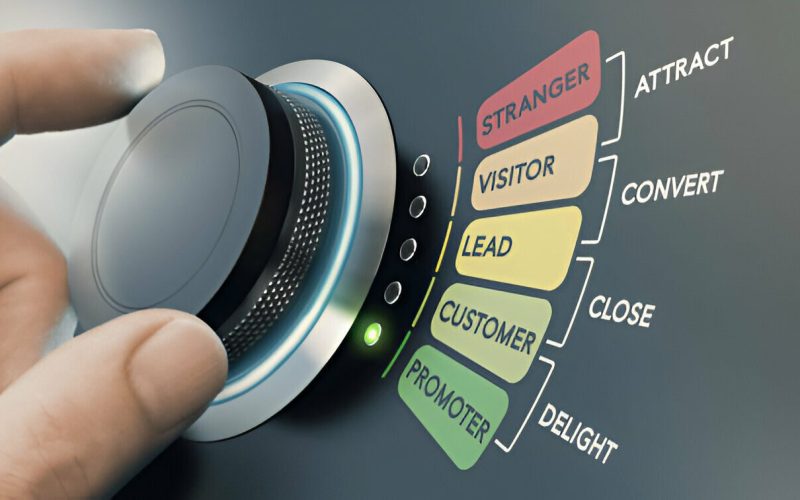
These leads have shown some interest or increased curiosity about the company, perhaps by downloading a free resource (ebook) or subscribing to a newsletter, an event or a webinar. Although they are not yet ready to make a purchase, they are more interested in your product or service, as well as more receptive to receiving additional information.

Cool leads or Marketing Qualified Lead (MQL)

These are leads that have shown a higher level of interest in the company’s products or services by asking or requesting information about them through a contact form, for example, and are willing to participate in sales conversations or discovery meetings.

Warm leads or Sales Qualified Leads (SQL)

These are leads that have demonstrated significant interest in the company’s products or services and meet certain qualification criteria, such as budget, authority, need and time (BANT). These leads are closer to becoming customers and require more personalised attention from the sales team.

Hot leads or Sales Accepted Leads (SAL)

These are leads that have expressed a strong interest in buying your product or service, are a good fit in terms of features, price, etc. and are ready to move on to future sales conversations and even request a formal proposal or quote. Their intent to buy is quite clear (although never absolute until they sign a contract) and they are at the final stage of the buying process or, in other words, at the bottom of the funnel.

Lost or inactive leads

These are leads that, for various reasons, have stopped interacting with the company (the famous ghosting) or have expressed their lack of interest in your product or service due to situations as adverse as they are varied (change of management of their company, rethinking of a certain strategy, etc.). Although they may represent a lost opportunity in the short term, they can still be the object of reactivation strategies in the future.

different type of leads

The importance of leads in a business

The importance of leads to a business lies in their ability to drive growth and profitability. Leads represent real business opportunities, as they are interested users who have expressed an interest in the company’s products or services.

By effectively capturing and managing quality leads, companies can nurture their sales funnel, increase their customer base and generate long-term sustainable revenue. In addition, well-qualified leads allow sales teams to focus their efforts on prospects with higher conversion potential, thereby optimising the sales process and improving operational efficiency.

In a competitive and constantly evolving market, a solid lead generation and management strategy is a key factor for business success.

For this reason, at Springboard35 we give paramount importance to the proper qualification of leads after thorough prospecting, and this unique and proven qualification methodology has allowed us to get to where we are: more than 20 years expanding more than 200 innovative technology companies in Southern Europe and Latin America.

If you would also like us to help your B2B technology company expand and grow its sales, contact us and we will discover together how to achieve your business goals.

Rate this post

What is a Market Research, and what is it for?

what is market research

Staying ahead of the curve and anticipating changing consumer needs and preferences is critical to business success in today’s entrepreneurial world. This is where knowing what a market research is comes into play, a powerful tool that can provide an invaluable competitive advantage. At SpringBoard35, we understand the crucial importance of market research for business and offer industry-leading services to help companies make informed and strategic decisions.

What is market research?

The question we have to answer first is, what is market research? It is a meticulous process of research and analysis that allows you to thoroughly understand the needs, preferences and behaviours of your potential customers. It is like having a magic compass that guides you to the treasure trove of business success.

And what is a market analysis?

It is the in-depth interpretation of the data collected in the market research. It is like deciphering an ancient map that reveals the secrets of the market and leads you to your target audience.

how to do a market research

Reasons to conduct market research

The reasons for market research are endless, but here are some of the most important ones:

  • Launch a successful product or service: Market research helps you identify demand and create products or services that meet the real needs of your customers.
  • Know your target audience: Discover in depth the demographic, psychographic and behavioural characteristics of your ideal customers.
  • Analyse the competition: Study the strengths and weaknesses of your competitors to differentiate yourself and stand out in the market.
  • Develop effective marketing strategies: Make informed decisions about pricing, distribution, promotion and communication to reach your target audience effectively.
  • Minimise risk: Reduce uncertainty and make the right decisions to protect yourself against unforeseen market events.

Phases of market research

A complete market study is divided into stages, and it is very important to know what they are. From Springboard35, we tell you what are the stages of market research:

  • Problem definition: Clearly identify the question that your market research needs to answer.
  • Market research: Collect qualitative and quantitative data through surveys, interviews, focus groups and secondary data analysis.
  • Data analysis: Organise and interpret the information collected to uncover patterns and trends.
  • Conclusions and recommendations: Present your findings clearly and concisely, and offer strategic recommendations for your company.
  • Implementation and follow-up: Put the recommendations into practice and monitor the results to evaluate the success of your market research.
market research

What is market research for?

Market research is a versatile tool, which is why it is important to know what market research is for:

  • Launch new products or services with a higher probability of success.
  • Develop effective marketing strategies that appeal to your target audience.
  • Improve the customer experience by understanding your customers’ needs and expectations.
  • Optimise your pricing to maximise your profits.
  • Strengthen your market presence and stand out from the competition.
  • Make informed decisions about the future of your business.

Why choose Springboard35 for your market research?

At Springboard35, we are experts in deciphering the enigmas of the market. We have a team of highly qualified and experienced professionals to guide you through every step of the process.

We offer you:

  • Customised market research: We adapt our methodology to the specific needs of your business.
  • Accurate and reliable information: We collect and analyse data with scientific rigour to guarantee the veracity of our results.
  • Innovative approaches: We use the latest research techniques to obtain relevant and actionable information.
  • Clear and concise communication: We present the results of your market research in a way that is understandable and easy to apply.
  • Commitment to your success: We are passionate about helping you achieve your goals and become a leader in your market.

Don’t get lost in the uncertainty of the market, let Springboard35 guide you to success!

Contact us today and find out how our market research can help you unlock the full potential of your tech business.

Rate this post

What is a Sales Manager and what are their functions?

Director comercial - Sales Manager

In the dynamic business world, knowing what a Sales Manager is is crucial, as he or she is a strategic player. In this blog post, from our Sales Consultancy Springboard35, we will explore in depth what it means to be a Sales Manager and what are the key functions they perform. From customer relationship management to process optimisation, you will discover how this professional contributes to the growth and success of companies. Join us on this journey to unravel the secrets of an effective sales manager.

What is a Sales Manager?

In the intricate business universe, the commercial manager emerges as a master strategist. This visionary leader goes beyond sales, being the architect who shapes commercial and sales execution. From team management to process optimisation, this key figure in sales and business development balances macro vision and micro execution to drive growth.

At Springboard35, we understand the challenges of today’s business landscape, and our team of business development experts is ready to partner with you. Discover how our services not only understand, but also optimise business manager functions, providing tailored solutions that drive efficiency and generate tangible results.

que-es-un-director-comercial-what-is-a-sales-manager

Functions of a Sales Manager

This key role plays a multifaceted role that goes beyond mere supervision. This figure plays a multifaceted role that goes beyond mere supervision. At Springboard35, we take an in-depth look at the functions of this key role, as they are essential to the delivery of your company’s business and commercial strategy.

Strategy and planning

The sales manager not only executes, but also designs. They immerse themselves in strategic planning, developing tactics that align business objectives with the overall vision of the company.

Team management

Leading effective teams is a crucial skill. From selection and training to constant motivation, the sales manager cultivates an environment conducive to optimal performance.

Customer relations

Customer relationship management goes beyond the transaction. The sales manager builds and nurtures long-term relationships by understanding customer needs and ensuring ongoing satisfaction.

Market analysis

Being aware of trends and competition is imperative. The sales manager analyses the market, identifies opportunities and adjusts strategies to keep the company at the forefront.

Process optimisation

Operational efficiency is key. The sales manager evaluates and optimises internal processes, ensuring that each operation contributes to overall success.

At Springboard35, we are committed to empowering each of these functions. Our holistic approach not only understands the complexities of the sales manager role, but also offers tailored solutions that elevate execution and generate tangible results for your business.

director-comercial-sales-manager

Skills a Sales Manager must have

In the competitive business world, being an effective sales manager requires a unique set of skills. At Springboard35, we break down the essential skills that we believe are crucial to leading in the commercial arena.

Persuasive communication

This person must be a master communicator, conveying ideas clearly and persuasively, both internally and externally.

Strategic leadership

The ability to lead teams towards commercial goals, combined with a strategic vision, defines the sales manager as a true leader.

Problem-Solving

In the face of unexpected challenges, the ability to analyse, adapt and solve problems effectively is essential to keep the operation running smoothly.

Customer orientation

Understanding customer needs and translating them into effective solutions is a crucial skill for building strong and lasting relationships.

Time management

With multiple responsibilities, efficient time management ensures that each task contributes to overall success.

At Springboard35, we recognise the importance of these skills and work tirelessly to leverage them in our Sales Managers. If you are looking for a partner who not only understands these skills, but also cultivates them, join us on this journey to effective and sustainable business leadership.

Rate this post

Industry 4.0 : the future of Digital Transformation

Industria-4.0-Industry-4.0

What is Industry 4.0 and where does the term come from?

The term Industry 4.0 was coined during the Hannover-Messe technology fair in Germany in 2011, although it was at the same fair in 2013 when the German government presented it as an initiative to improve the industrial fabric and with the aim of providing greater flexibility and individualisation of production processes.

The founding document of Industry 4.0 and the associated platform (Platform Industrie 4.0) called Recommendations for implementig the strategic initiative Industrie 4.0 was drafted by Acatech (German National Academy of Science and Engineering) and presented in April 2013. https://en.acatech.de

The concept of Industrie 4.0 is thus based on a profound process of digital transformation of Industry, the fourth industrial revolution brought about by advances in information and communication technologies.

But why "4.0"?

Historically, the industrial revolution is the period in which a process of economic, social and technological transformation took place, which began in the second half of the 18th century in Great Britain, and which was reproduced decades later in much of Western Europe and America.

This period saw the greatest economic, technological and social transformation in the history of mankind since the Neolithic period, which saw the transition from a rural economy based primarily on agriculture and trade to an urban, industrialised and mechanised economy.

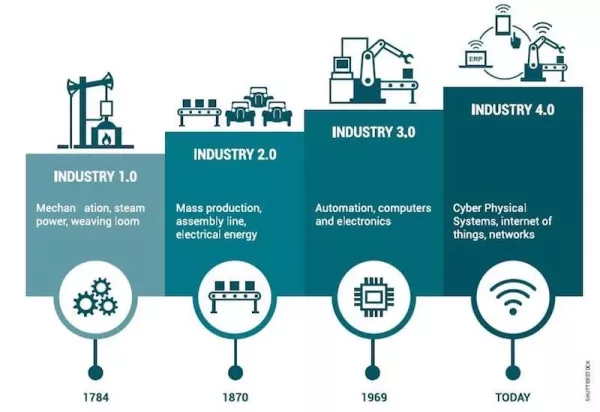
This transformation has been called Industry. 1.0 to give way to the following transformations that changed the productive environment.

industria-4.0-industry-4.0

But industrial digitalisation already had its antecedents before the Industry 4.0 concept was formulated. The introduction of automatons and robotics was already widespread in the most demanding environments such as the automotive industry.

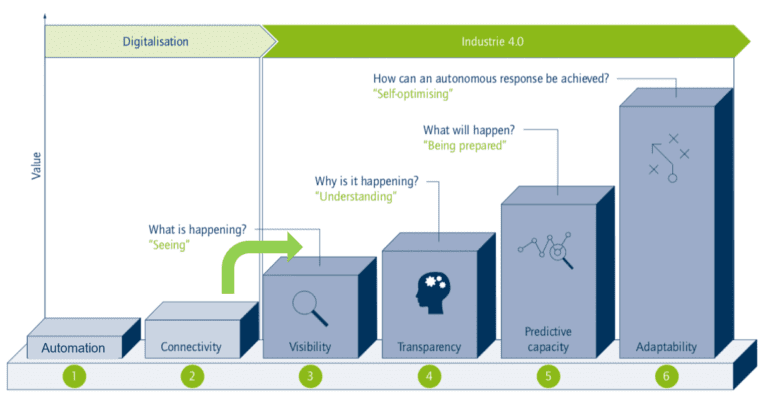
The next challenge was to interconnect, visualise, understand, anticipate and make a production system self-adjusting to the conditions.

The challenge was there, to grow in these areas that would make industrial environments capable of evolving and adapting to changing economic times and market demands.

industry-4.0_industria-4.0

Focus areas of Industry 4.0

  • Monitoring.
    • Sensorisation, data capture and analytics will improve the ability to see and understand processes.
    • Technologies: IIoT, Big Data, AI, predictive and proactive maintenance.

The main need of any production environment, as we showed earlier, is to gain in visualisation in order to know and understand the process better. Obtaining a large amount of data from various sources allows the process to be better contextualised and the application of advanced analytics and AI will allow measures to be applied to correct defects, anticipate them and optimise consumption of material or resources.

  • Simulation.
    • It is not necessary to wait for an event to occur before taking action.
    • Technologies: Digital Twin, Virtual Reality (VR) and Augmented Reality (AR).

In so-called mass production, optimisation is the big challenge. The operational margins of the products are very small and therefore there is very little capacity for cost deviation. Improving productivity means anticipating to minimise or eliminate the dreaded “unscheduled downtime” in mass production. “Unscheduled downtime” on a production line.

The acquisition of a large volume of data together with the computational and analytical capacity, makes it possible to virtually reproduce not only assets but also processes or systems. This. Substantially improves the ability to anticipate events and take action to avoid them.

  • Zero-defect manufacturing.
    • Claim of very demanding environments such as aeronautics, automotive or railways.
    • Technologies: IIoT, interconnection of systems, data analytics.

For years now, in safety-critical sectors, a large number of controls have been implemented to limit the possible failures of the most sensitive elements. This supervision was done by the final assembler, but this meant a great effort of coordination and consequently an increase in costs.

Subsequently, these control systems were transferred to the members of the supply chain to homogenise and dilute costs, but this represented an increase in errors and bidirectional management that generated a great deal of complexity. Intelligent production coordination systems bring together information from the initial design phase through to after-sales and/or end-of-life.

This makes it easier and more consistent to close any gaps that may exist, bringing traceability to the heart of reliability.

  • Customised manufacturing.
    • Companies need to improve their offer, customising the products they sell. Automotive, retail, textile.
    • Technologies: Adaptive production models, production scheduling management, additive manufacturing (3D printing).

Customers have always had the aspiration to personalise their purchases beyond the catalogue offer that any company has. Likewise the just in time model tried to alleviate the problem of stocking large quantities to ensure supply and cost. Flexibility was the most desired feature in order to be able to meet new customer demands and even improve demand.

This means having production machines capable of changing production orders more quickly and even being able to individualise an order (e.g. fashion). More efficient coordination with production order management systems, complete coordination of production lines, allows shorter series to be produced. In addition, the emergence of additive production systems makes it possible to create unique products from almost any material.

  • Energy efficiency
    • Bringing energy costs to optimal levels to improve profitability.
    • Technologies: IIoT and monitoring, integrated management, Smart energy.

Reducing production costs is not only about optimising the amount of material used or labour costs. It also involves acting on the highest operating cost of any production centre: energy.

Energy efficiency means having the capacity to analyse the energy consumption that is being produced and to optimise it.

Improvements in the capacity to collect information on consumption at any point by means of increasingly larger and cheaper devices, as well as their monitoring and intelligent analysis, have made it possible to rationalise this consumption in order to reach an optimum point.

The emergence in industry of a multitude of solutions that address each of these areas from different perspectives, and many others that complement them, is allowing the sector to move ever closer to the objectives of Industry 4.0.

But there is still a long way to go, and it is necessary to understand from a global point of view that digitalisation is a unique way to turn current production systems into a reality.

Our expertise in the Industry 4.0 sector

At Springboard35, as an IT Business Development consultancy, we have been helping technology companies with innovative solutions for the industrial sector to expand in the markets of Southern Europe and Latin America for many years.

Our added value lies in the recruitment of specialised technical talent, with a background in the industrial sector and a very meticulous training in commercial consultancy and consultative sales, having developed over the years our own successful methodology that has allowed us to stand out and verticalise in this sector.

From IIoT solutions (Industrial IoT), AI or data analytics, we have boosted a multitude of technology startups and scaleups, allowing them to grow quickly, agile, safe and sustainable, optimising their commercial investments and allowing them to achieve their expansion goals.

If you also have a technology company with an innovative and disruptive solution (or several) for the industrial sector and you would like to increase your sales, you are in the right place; contact us at info@springboard35.com or through our web form and find out how we can help you grow in your current market or launch your solution to new markets… What are you waiting for?

Rate this post

Find out what SDR sales force is and how to apply it.

sdr-sales-representative

From our Business Consultancy we offer this comprehensive guide to what is SDR sales force and its effective application in the business world. In this article, we will explore in detail exactly what the SDR sales force is and how you can harness its potential to drive the growth and success of your business. The SDR sales force is a fundamental pillar of any business strategy, and understanding its role in the sales process is essential to achieving outstanding results.

Throughout this reading, we will unravel the key characteristics of what makes an effective SDR sales force, the strategies that maximise its performance, and how to align it precisely with business objectives. Get ready to discover how to create an exceptional sales team and boost your business results to unimaginable levels. Let’s dive into the fascinating world of the sales force and take your business to the next level!

What is an SDR sales force and why is it crucial for your business?

An SDR sales force is a team of professionals who function as Sales Representatives, acting in the early stages of sales (pre-sales).

This team is highly trained and specific, and its main objective is to boost a company’s sales and revenue by increasing opportunities. This sales force is in charge of mapping and prospecting markets in depth, according to a predefined Go To Market strategy, in order to obtain and qualify the best possible leads for your company and product and, thus, nurture your funnel at the top of it, prioritising quality over quantity.

In today’s competitive business landscape, the SDR sales force plays a vital role in the growth and success of any business. It is the essential bridge between your company and your customers, allowing you to quickly expand your customer network. With their ability to identify needs and solve problems, the SDR sales force can influence buying decisions and close qualified meetings (SQLs) for your team of sales closers (Account Managers/Executives, etc.) to close.

Having an effective SDR sales force not only increases sales opportunities, but also improves brand awareness and customer satisfaction. Discovering the potential of the SDR sales force and how to apply it properly in your business will be key to achieving sustainable success and differentiating yourself in an increasingly competitive market.

que es una fuerza de ventas sdr - what is an sdr salesforce

Characteristics of an effective SDR sales force

An effective SDR sales force is distinguished by a combination of skills, knowledge and attitudes that make it an invaluable asset to any business. First and foremost, members of this team must possess excellent communication skills and empathy to connect with customers and understand their needs.

In addition, active listening skills are crucial to identify opportunities and offer customised solutions. Perseverance and determination are also key characteristics, as the first qualified meeting (SQL) may take time and effort to close.

In-depth knowledge of the company’s products or services and the market in which they operate is essential to provide reliable and persuasive advice. Likewise, adaptability and the ability to learn and evolve with changing market demands are critical to remaining competitive.

Ultimately, an effective SDR sales force is characterised by its passion for success, professional ethics and results orientation. With these qualities, the sales team can become a true growth engine for your business, building strong customer relationships and maximising business opportunities.

Effective sales strategies and how to apply them

Effective sales strategies are at the heart of commercial success, and applying them in an intelligent and focused way is essential to achieve outstanding results. First, a thorough understanding of the sales process and proper market segmentation will identify the most promising prospects.

Personalisation is key in today’s business era, and tailoring strategies to meet the unique needs of each customer will significantly increase conversion rates. In addition, the use of technology and digital tools can streamline and improve the efficiency of the entire sales process.

Maintaining an analytical approach, measuring the performance of strategies and making data-driven adjustments is critical to continually improving business results. With these strategies applied in a consistent and customer-centric manner, your sales force will become a powerful growth engine for your business.

que-es-task-force-sdr

The power of a Task Force in challenging situations

In times of business challenges, a Task Force becomes a powerful and agile tool to address critical situations. This elite force, composed of multidisciplinary experts, focuses on solving problems quickly and effectively. With its ability to make strategic decisions and coordinate precise actions, the Task Force becomes a catalyst that enables companies to deal successfully with adversity and emergencies.

What is a Task Force and its advantages in the business world?

A Task Force, also known as a task force, is a select group of highly trained professionals specialised in different areas. Its purpose is to address specific challenges within an organisation and find effective solutions in record time. The Task Force has the advantage of having a wide range of skills and perspectives, allowing it to solve complex problems in an agile and efficient manner. In the business world, this tool has become a crucial mechanism to address critical situations, drive innovation and overcome obstacles with determination.

How to create and lead a successful Task Force

Creating and leading a successful Task Force requires careful planning and execution. First, identify the most qualified and committed professionals in each relevant area. Establish clear goals and defined roles for each member, fostering open and collaborative communication. In addition, ensure that you have inspirational leaders to motivate the team and guide the problem-solving process. Provide adequate resources and a working environment that fosters creativity and innovation. With a solid strategy and effective leadership, your Task Force will be prepared to meet any business challenge successfully.

Rate this post